Continuing Education - Flow Differential Method™ A New Clinical Framework for Understanding Neck, Shoulder, and Hip Dysfunction
Most clients come in pointing to the place that hurts: the neck, the shoulder, the low back, the hip, the knee, or the foot.
But the painful area is not always the starting point.
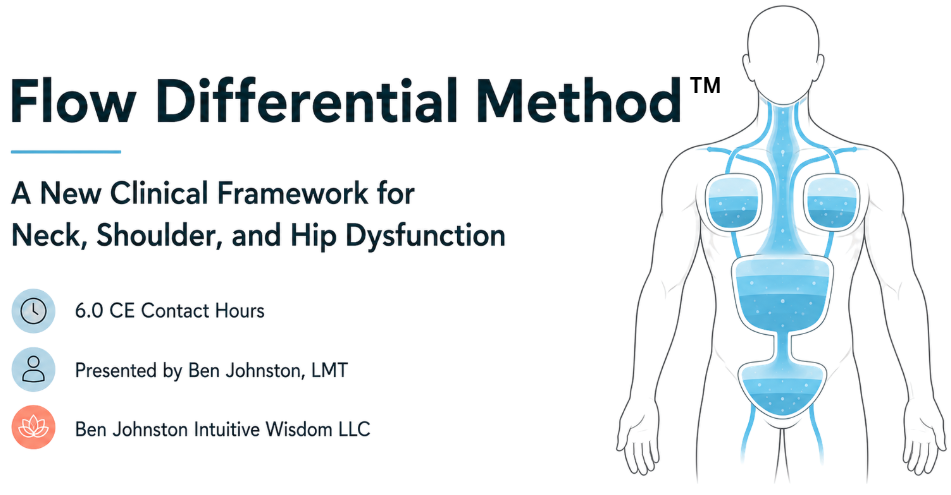
This class introduces massage therapists to the Flow Differential Method, a clinical framework that looks at how pressure, compensation, and tissue resistance move through the body. Instead of chasing symptoms, you will learn to assess how the anterior torso, ribcage, core, shoulders, hips, and extremities influence one another.
The goal is not to memorize a routine. The goal is to understand how to think through the body in sequence.
Upcoming Class
Flow Differential Method: Intro to Torso-Driven Compensation Patterns
Date: Saturday, September 12th, 2026
Time: 9:00 AM to 4:30 PM
Format: In-person, hands-on continuing education
Class Size: Limited to 6 participants
Location: Ben Johnston Intuitive Wisdom, North Liberty, Iowa
Investment: $222
CE Credit: 6 hours
This Class Is Designed For Massage Therapists Who Want More Than Another Technique
Designed for licensed massage therapists seeking continuing education credit and a stronger clinical framework for assessment and treatment planning.
It is especially useful for practitioners who work with clients experiencing:
Neck tension, shoulder restriction, chronic hip tightness, ribcage compression, low back compensation, nervous system guarding, postural strain, athletic overuse, hypermobility, or recurring pain patterns that do not resolve by working directly on the painful area.
What You Will Learn
1. Why Pain Is Often the Last Place to Look
Learn why the loudest area in the body is not always the area creating the compensation.
2. The Torso as a Pressure and Compensation Hub
Explore how the core, ribcage, sternum, and chest wall influence the neck, shoulders, hips, and extremities.
3. First-Contact Assessment
Practice simple body-reading and palpation concepts that help you identify where the system may be holding pressure.
4. Neck and Ribcage Counterbalance
Understand how anterior ribcage restriction can influence posterior neck tone and upper trap tension.
5. Shoulder and Lower Core Relationship
Learn how lower abdominal and anterior core restrictions can affect shoulder activation and arm function.
6. Hip, Toe, and Lower-Body Flow Patterns
Explore how hip priming and lower-body activation can shift strength, stability, and client perception.
7. Client Communication and Consent
Learn grounded language for explaining sensitive areas, including sternum, ribcage, lower core, and chest wall work.
This Is Not a Sit-and-Listen Class
This class includes lecture, demonstration, body observation, guided palpation, partner practice, and discussion. You will watch the method applied, feel changes in your own body, and practice observing how one area of the body can influence another.
Because the class is limited to 6 participants, each therapist has space to ask questions, receive feedback, and develop a more embodied understanding of the work.
Class Demonstrations May Include
Neck and Ribcage Counterbalance
Observe how sternum and ribcage work may change neck palpation, range, and tissue tone.
Shoulder and Lower Core Connection
Explore how lower core restriction can affect shoulder range, activation, and arm function.
Toe Test and Hip Priming
Learn a simple demonstration showing how hip activation can influence foot and toe strength.
Hypermobility Considerations
Discuss why range of motion is not the same thing as readiness, stability, or functional capacity._
A Framework, Not a Formula
Many continuing education classes teach a new technique. This class teaches a way of seeing.
Flow Differential Method helps therapists ask better questions:
Where is the body protecting?
Where is pressure being stored?
Where is the compensation being redirected?
What changes when the torso is addressed first?
How does the client’s body respond in real time?
This gives you a clearer way to work with complex clients without needing to force deeper pressure, chase pain, or rely only on isolated muscle-by-muscle thinking.
Professional, Consent-Based, Clinically Grounded
This class includes discussion of the ribcage, sternum, lower core, chest wall, and hip region. All work is taught with professional draping, clear consent, appropriate boundaries, and respect for client comfort.
The focus is clinical education, body mechanics, nervous system response, and therapeutic decision-making.
Join the First Flow Differential Method CE Class
This first class is intentionally small so participants can receive direct instruction and guided practice. If you are ready to expand how you assess the body and stop chasing symptoms one area at a time, this class is the starting point.
Only 6 spots available.
FAQ Section
Do I need prior experience with Flow Differential Method?
No. This is the introductory continuing education class and the starting point for future FDM trainings.
Is this a hands-on class?
Yes. The class includes demonstration, partner practice, observation, and guided discussion.
Who can attend?
This class is designed for licensed massage therapists seeking continuing education credit and professional skill development.
Physical therapists, occupational therapists, chiropractors, athletic trainers, and other movement or bodywork professionals are welcome to attend. However, participants outside the massage therapy profession should verify independently whether this course qualifies for continuing education credit within their licensing requirements.
What should I wear?
Wear comfortable clothing that allows movement and appropriate hands-on practice.
Will this count for CE credit?
This class is designed as a 6-hour continuing education class. If you have a specific state or licensing board requirement, please confirm that this class meets your renewal needs before registering._
Future 2026 Class dates:
September 19th
October 10th
October 24th
November 7th
November 21st
December 5th
December 19th
Disclaimer: This website is independently owned and operated by Ben Johnston Intuitive Wisdom LLC. All content, ideas, and opinions expressed here are my own and do not reflect the views, policies, or practices of any other parties.
